 Just in time to save me from the gaping void left behind by the demise of Tony Soprano, FX has come along with Season 4 of Rescue Me. Tommy Gavin, my all time absolute favorite Irish, rage-aholic, 911-PTSD addled New York bad boy firefighter with the never ending stream of woman troubles, is the creation of one of my fave crushes, Denis Leary; of the wicked sense of humor and great taste in music. So even if the show wasn’t as brilliant as it is, I’d probably still tune in. As it is, the show is visceral and entertaining, an intelligent emotional rollercoaster that hones in on issues of the day like a heat seeking missle. I also appreciate the smart, strong, deeply flawed and funny women who populate this show; they are more consistently realized than any female characters I can think of on any screen, large or small, in recent memory. Last week’s show stopper was a cat rescue in a crumbling warehouse scene, in which the guys find themselves sliding to their certain deaths into a wall of fire. All of this while cats fall out of the ceiling to the tune of the B-52s “Dance This Mess Around.” The birds-eye view of a cat looking into the flaming abyss is priceless, and a good sign that Leary hasn’t lost his edge.
Archive for the ‘POST’ Category
So long Tony, hello Tommy!
Posted in Denis Leary, POST, Rescue Me on June 20, 2007| Leave a Comment »
Bada Bing, Bada Boom
Posted in Opinion, POST, The Sopranos finale on June 11, 2007| Leave a Comment »
 One of the tensest scenes I’ve ever watched, and what really happened? Carmela walks in, sits down and starts looking at the menu. AJ walks in and flops down. A man walks through the door and sits at the counter. Meadow can’t parallel park her car to save her life. A couple more guys walk in and look at the jukebox. Meadow still can’t park her car. The guy at the counter walks into the bathroom. A basket of onion rings arrives at the table and the family starts popping them into their mouths. Last thing Tony sees is his daughter Meadow walking through the door. That infernal Journey song, “Don’t Stop Believing,” And then, darkness and silence. And it wasn’t the cable, because finally, the credits roll.
Like Proust, like a baseball game, like life itself, the Sopranos gave us the hum and the mundanities of daily life punctuated with episodes of tragedy, horror, grief and pathos. And laughter, let’s not forget the laughter. You gotta focus on the good times, right?
If Meadow had walked in and taken her seat next to her father, the hit man might never have had his opportunity. As it is, he had a clean shot. Or not. We just don’t know. Unlike Proust or a baseball game, but just like life, you’ll never really know.
Unlike the FBI guys, I’ll never win or lose my bet.
RIP, T.

Forget Omar Ahmed Khadr, Free Paris
Posted in Paris Hilton, POST on June 5, 2007| Leave a Comment »


Peonies, Parsons, Springtime at the Sunday Market
Posted in Farmers' Market, Los Angeles, Peonies, POST, Recipes, Russ Parsons, Sustainable farming on June 3, 2007| Leave a Comment »


It’s Sunday and spring has officially arrived at the market. Perhaps even more than for the cherries and apricots, I get there early to grab a few fragrant bunches of peonies from Ha’s Farm. Peonies are very expensive in Southern California. They require a hard freeze in the winter so they are scarce. I grew up with peonies; they became the Indiana state flower in 1957 (replacing the zinnia) and they used to carpet my grandmother’s back yard in the spring. But when I first moved to California I was shocked to find them wrapped in precious bundles of three at $10 a stem. David and Yeung Ha farm in the hills of Tehachapi, so they can grow tree peonies and bring them by the bucket full for three short weeks in the Spring(at $2 a stem). They are more famous for their Fuji apples that taste of honey, and also the delicious jams and delicious apple turnovers. But the peonies in the spring are my favorites. Peonies have a prolific but sort lived season, which make them all the more precious. As if they needed anything beyond their old fashioned beauty, they also open in stages, starting off as plump fluffy blossoms and metamorphizing into delicate lacy blooms. Every day, a new bouquet.
Also at the market this AM was Russ Parsons and his new bo ok How To Pick a Peach. Now I can throw away a bunch of his clippings from The Los Angeles Times. I also have some good reading ahead of me. Parsons is a good home cook with lots of great chef friends, so if his recipes don’t always seem original, its not really the point. Every recipe I’ve ever tried of his works out perfectly – the scale and technique are designed with the home cook in mind. Parsons has dedicated this book to fruits and vegetables in season and divides the book accordingly. Each section includes essays on such topics as farming techniques of small and large scale farmers, kitcehn chemistry and what to look for and how to store (and cook) fresh fruits and vegetables If reading about the effects of global competition on American agricultural practices makes you feel tart to feel a bit disheartened, cheer yourself up with recipes like “tart of garlicky greens and black olives”, “overcooked green beans” and “strawberries and oranges in basil syrup” – all in season at the moment.
NASA’s Exit Strategy
Posted in Gregg Easterbrook, Michael Griffin, NASA, NPR, Opinion, POST on June 1, 2007| Leave a Comment »
 When I was little I had a disturbing recurring dream. I was with my parents, and my little sister and brother. Suddenly, the four of them broke away and started heading for a rocket ship. They were leaving me behind. I tried to catch up, but it was one of those situations where no matter how hard I ran, I wasn’t able to get anywhere. I was scared, but also, I was pissed.
Even though I now think the rocket ship is incidental to the fact that, due to the presence of my siblings I was no longer the center of my parental universe, I have transferred my feelings of fear and loathing onto NASA. Not rational I know, but these things seldom are.
After today though, I no longer feel I have anything to apologize for, having heard comments from NASA administrator (and Bush appointee) Michael Griffin in an interview with NPR’s Steve Inskeep this AM. His comments were in response to a scathing criticism of NASA’s culture delivered yesterday by Gregg Easterbrook, a former global warming skeptic who has seen the light. In a nutshell, Easterbrook feels that NASA is squandering taxpayer dollars and consuming massive amounts of the earth’s non renewable resources on programs that have little evident value. Easterbrook feels that NASA should spend some of the money it wants to spend on moon landings and takeoffs on the study of the earth and global warming instead. Sounds reasonable enough to me. But Mr.Griffin feels differently.
In an interview that had me hoping I was just having another bad dream, Griffin responded to Inskeep’s queries (this is lifted from NPR’s website, italics are mine).
Inskeep: It has been mentioned that NASA is not spending as much money as it could to study climate change — global warming — from space. Are you concerned about global warming?
Griffin: I’m aware that global warming exists. I understand that the bulk of scientific evidence accumulated supports the claim that we’ve had about a one degree centigrade rise in temperature over the last century to within accuracy of 20 percent. I’m also aware of recent findings that appear to have nailed down — pretty well nailed down the conclusion that much of that is manmade. Whether that is a longterm concern or not, I can’t say.
Inskeep: Do you have any doubt that this is a problem that mankind has to wrestle with?
Griffin: I have no doubt that … a trend of global warming exists. I am not sure that it is fair to say that it is a problem we must wrestle with. To assume that it is a problem is to assume that the state of Earth’s climate today is the optimal climate, the best climate that we could have or ever have had and that we need to take steps to make sure that it doesn’t change. First of all, I don’t think it’s within the power of human beings to assure that the climate does not change, as millions of years of history have shown. And second of all, I guess I would ask which human beings — where and when — are to be accorded the privilege of deciding that this particular climate that we have right here today, right now is the best climate for all other human beings. I think that’s a rather arrogant position for people to take.
Beyond the fact that his own point of view seems a wee bit arrogant, I don’t really think he’s expressing what he really feels. I think he’s one of those bloodless cyborgs who believes in using taxpayer money and NASA brain power to engineer an exit strategy once this planet stops being so hospitable. Those of us not fortunate (or powerful) enough to be part of the inner circle will be left behind left behind to choke on NASA’s non- renewable exhaust.
Lounge preferences among apartment dwellers in Marina Del Rey
Posted in Amy Scattergood's Pavlova, Los Angeles, POST, Recipes on May 29, 2007| Leave a Comment »

Leslie has a high rise apartment overlooking the Marina and fun friends, so her parties are always worth making the trek down the 405. She invited a group over on Memorial Day to lounge on her patio overlooking the Marina, and then lounge by the pool, and then lounge some more on the rooftop deck. When we weren’t lounging we examined the meaning of the patios lined up in a tidy row on the building next door. Bright primary colors indicate the presence of children, potted palms and a buddha suggest a quest for inner peace, several rows of pottery barn chaise lounges imply an aspirational lifestyle. Then it was time for dinner which included a pork shoulder braised with beer and herbs in a crock pot that’s almost as stylish as Leslie is (Hamilton Beach, about $50). She served it with black beans, cole slaw and green salad. Simple and delicious!
 I brought the desert. I found a recipe in last week’s LA Times for a pavolva and 3 pints of strawberries from McGrath Farms waiting to be given their due, so why not? I reduced the amount of cornstarch used and halved the recipe. I used canned whipped cream and store bought lemon curd for the filling. Because of the reduced cornstarch, my meringue didn’t hold its shape, but it had a light, velvety mouth feel that was worth the sacrifice. Next time I’ll try cream of tartar or tapioca flour instead of cornstarch.
Use the left over egg yolks to make an aioli
First:
Preheat the oven to 350 F
Cut an 8 inch circle out of parchment paper and place on a cookie sheet.
Then on to the recipe:
Whip 5 egg whites on medium high in a stand mixer using the wisk attachment until they form stiff peaks
Add:
1 cup sugar, added in a steady stream to the egg whites at medium speed until incorporated
Then:
1 Tablespoon cornstarch until incorporated
Then:
1 tsp white wine vinegar
1 tsp vanilla
Spread the meringue onto the parchment paper. Try to keep the sides high, with a slight indent in the middle. Place into the oven and then reduce the heat to 300F. Bake about 30 minutes, then look to see if the outer layer of the meringe is hardened. Cool in the oven with the heat turned off.
While the meringue is in the oven, prepare the strawberries, as many as you want ( a couple of pints probably) cutting them as you see fit, sprinkling them with a little sugar and balsamic vinegar. Set aside.
When ready to serve:
Combine 1/3 jar of lemon curd with some canned whipped cream (I used Land o Lakes light whipped cream). First whisk the lemon curd into a sauce, then fold in the whipped cream to taste.
Spread the lemon curd mixture into the center well of the meringue.
Pile the strawberries on top.
Cut wedges with a serrated knife.
It’s that simple and while it is being eaten, you will be beloved.
On and about L.A., part deux
Posted in Blogroll, dance, Los Angeles, POST, Sylvie Guillem on May 6, 2007| Leave a Comment »

Last Wednesday, I went to Royce Hall, on the UCLA campus, to see Sylvie Guillem and Akram Khan perform a 75 minute work they call Sacred Monsters.


They are as unlikely a pair as could be. Guillem is the famous French Prima Ballerina discovered by Rudolph Nureyev, and Khan is a British-Asian dancer and choreographer known for fusing Western contemporary dance with Indian classical kathak. Tall, fair, impossibly narrow Sylvie is adored for her seemingly jointless body, amazing extension, feet to drive the fetishist mad with longing, and impeccable lyricism. Kahn is dark, compact, percussive, and his roots are firmly planted in classical Indian dance. But of course the pairing works; his dark to her light, her melody to his rhythm, ying meets yang – you get the idea.
At first I found myself wishing I’d seen Guillem in her hey day as a ballerina dancing Raymonda or Swan Lake. But then I realized I was watching something far more intimate and original, and I got lost in the pair’s remarkable pas de deux that seemed to cover the full range of human emotion in a light but still penetrating way.
It wasn’t a typical pas de deux by any means. Sometimes one performed solo as the other sat nearby on stage, sometimes they performed together, and at other time they performed at the same time, but apart from one another. At one point Guillem sat and braided her hair. At another the two chatted while mopping the floor by dragging towels around with their feet. But they always worked in relation to one another, as artists, as woman and man, as inhabitants of two distinctly different worlds reaching out to discover something new.
Through dance, dialogue and music they touched on themes of fame, doubt and expectation, and ended by performing what looked very much like children jumping rope.
I was disarmed completely and it was a fantastic ending to an otherwise tedious day. I drove home with my shoes off and the sun roof open . The moon was full and the music, a mesmerizing mix of live voice and Western and Eastern instruments, stayed with me the whole way home.
Here is video of Sylvie performing Raymonda:
Still horse crazy after all these years…
Posted in Horses, Personal, POST on April 29, 2007| Leave a Comment »
Now that Matt Lauer has moved onto his infomercial for the travel industry, I can turn to a different, and personally more satisfying obsession: HORSES!

Last night, I saw a PBS documentary on Proud Spirit, a horse sanctuary in Arkansas. I realized just how horse crazy I still am.

It all began when I read Black Beauty. This is who and where I wanted to be when I was about 7 years old:

Since a real pony and a change of environment weren’t in the cards, I started obsessively collecting books and plastic horse models.


But I didn’t really meet one until I went to Vermont to visit relatives of my mother’s, who raised Morgan horses. I was 7 or 8 at the time, and those horses were very tall! Also, I had never been near a stable before and wasn’t used to the smell of horse manure. There were a lot of men around, stable hands who seemed kind of aloof. Needless to say, the reality of this first encounter did not match the fantasy.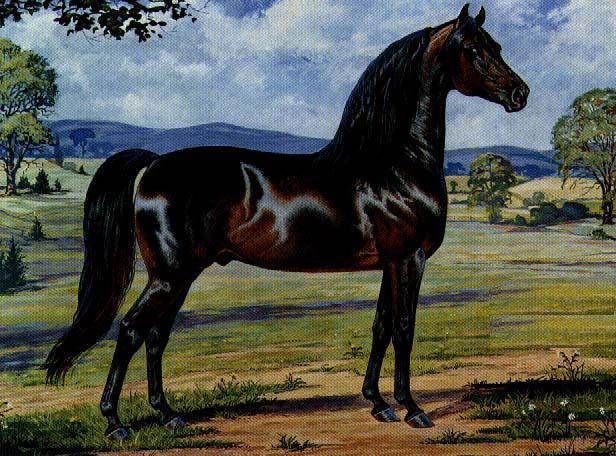
I didn’t meet my next horse until my family moved to a suburban neighborhood just this side of rural, and there was a field with a cranky pony living in it who bit my thigh when I tried to feed it roses. The bruise, really a huge blood blister, covered most of my thigh and hip. But even so I liked that pony; I could see he had a point of view. I didn’t find myself around horses again until I moved to Santa Barbara, and got it in my head that I wanted to ride English style. I took lessons for a while but never really got the hang of it, or rather I never got over the fear of being thrown.

I did befriend one horse, a quarter horse named Port, who had a reputation for being arrogant, but for some reason he liked me. He had the most beautiful canter, but he did not like to gallop. I used to groom and exercise him and ride him around the ring until the lessons got too expensive and I had to stop. Oddly enough, I somehow got on the subject of Port at dinner the other night, and then when I came home and saw the PBS documentary on horse rescue, my memories all started to come back to mingle with feelings of love and the fear, and then revulsion, when they started talking about Premerin ponies.


Fantasy meets reality, indeed.

Who in the #@%!! is Matt Lauer?
Posted in Personal, POST, Psychology on April 20, 2007| Leave a Comment »
 I wasn’t going to weigh in on the recent tragedy at Virginia Tech, but after 3 days of watching NBC’s Today Show host Matt Lauer’s petulant, reactionary coverage, I just have to join the fray.
Take this exchange on Tuesday between Lauer and Omar Samaha, whose sister Reema had been murdered:
Lauer: is there anything but anger in your heart for this young man who committed these crimes?
Samaha: Angry? I can’t even say I’m angry yet…There’s nothing that’s going to bring my sister back…and that’s bottom line to me…we’re not the only ones…its important the community is coming together because we are all family here.
I was impressed by Samaha’s reply and the way he dodged, unwittingly or not, Lauer’s vulgar leading question. When Lauer turned back to face the camera, I wasn’t sure if the anger in his expression was due to the story he was covering, or the fact that Samaha didn’t utter the words he wanted to hear.
**************************************
This morning as the details of Seung-hui Cho’s psychological profile came more clearly into focus, Lauer found it important to stress, at least twice, that Cho was not depressed, that he was psychotic. He spat the word “psychotic” out with an edge of disparagement in his voice, as if Cho had chosen psychosis over the more palatable diagnosis of depression as some sort of lifestyle choice.
**************************************
At the turn of the 20th Century authors such as Theodore Dreiser illuminated the harsh realities behind the fiction of the American Dream. In Dreiser’s novel “An American Tragedy” which was based on a true 1906 murder case, the protagonist ( Clyde Griffiths) is found guilty of drowning an ex girlfriend whose murder he pre-planned but did not actually commit. In Dreiser’s fiction Clyde Griffiths was victim of a confrontation of class, money and a need to possess something he thought had been promised to him. Provocative at the time, this theme became a well known and often retold perspective on life in America. At the turn of this century, we are seeing the new, less personal but no less sorrowful ‘American Tragedy,” a confrontation of disenfranchisement, glorified gun culture and misplaced rage being increasingly played out in front of our collective eyes through the media. Instead of great authors revealing the truths of our culture through fiction, we have glowering numb-skulls like Matt Lauer spinning fiction, conjecture and blame before the truth can even unfold.
**************************************
It seemed to me that it would be at least three days before the information I needed to know to begin understanding this case would come to light, and I wasn’t wrong. Beyond the obvious conjectures about his issues with women and disdain for the rich, the details of Cho’s psychological profile are very sad indeed. Multiple complaints of stalking behavior filed by VT coeds, teachers, counselors and acquaintances (he appears to have had no friends) worried about his behavior and his lurid writing, an involuntary stay in a mental hospital during which he was assessed as an imminent danger to himself or others and then released ( a complicated mess of free will and privacy rights), parents who seem to be invisible, the ease with which he was able to lie on his application and purchase his handguns from a dealer who thought he looked like a clean cut college kid; all of these indicators, and still he slipped through the cracks so easily. Like his Columbine mentors before him, Cho is the face of the new American Tragedy, and as things currently stand, we should brace ourselves to see much more of it in the future.
On and about L.A.
Posted in Farmers' Market, Los Angeles, Personal, POST, Sustainable farming on April 16, 2007| 1 Comment »
 Rock and roll, baby girl. You can do it. It’s all in your head.” …so said a street drifter in Beverly Hills as I was hurrying blindly towards my car. Silly as it may seem, those words did cheer me up, and they made me aware of just how much I was in my head at that moment – I hadn’t even see the guy as I walked past. As it turns out, it was a beautiful late afternoon, the air smelled of blossoming tress and there was plenty to observe on the boulevard: people sitting and talking in cafes, Japanese teens with mullet haircuts dressed head to toe in Chanel, a pug with a bejeweled collar sniffing the air…

Speaking of sniffing the air, I turn my attention now to an article that appeared in last Wednesday’s L.A. Times food section and sent a chill or horror down my spine. Russ Parsons wrote about the future of farmers’ markets, which is to say that they may become a thing of the past. Why? Because, as Howell Tumlin, executive director of the Southland Farmers’ Market Assn., is quoted as saying, “As a business model, farmers markets couldn’t be more inefficient.” Farming is generally a lean operation, and farmers are spending so much time driving to the various markets scattered all over the southland (Parsons counts close to 100) that they have little time left over for their fields and groves. remember my first lesson in farmers’ market economics, when my favorite farmer confessed that he was selling all his fresh shell beans directly to area restaurants, rather than holding back a few pounds for people like me. Hey, I thought, what about me? Do I now have to go to restaurants and pay their jacked up prices for something I take so much pleasure in cooking at home? But when you look at it from the farmer’s perspective, you just have to understand. What if I don’t show up that week? What if a pound or two doesn’t fit my budget? The restaurant is a bird in the hand. And I am not the safest bet, even I have to admit (I should say, however, that they do bring fresh shell beans to market more and more often, perhaps because the restaurants have made them so popular). Though so far I have lost only one favorite farmer to the full time restaurant supply trade (and they do show up in the summer with their surplus of magnificent heirloom tomatoes), my friend Mary has had to say good-bye to several beloved farmers, because of the economics of selling at Ferry Plaza in San Francisco, which started up as a block of vendors and has now turned into a foodie mecca, replete with permanent shops and restaurants selling everything from gourmet chocolate to olive oil to Christmas cakes imported from Emilia-Romagna, Italy – all at premium prices. My market isn’t nearly so grand. In fact it’s a little funky, as befits its Hollywood neighborhood, which at 8AM on a Sunday, is barely getting over last night’s after hours party when the farmers roll in with their trucks. What will happen if the farmers’ markets lose their farmers to Econ 101? No one is proposing that they sell exclusively to restaurants and grocers, though Whole Foods is making a big push towards local and sustainable, and sports banners with profiles of the farmers they buy from in their produce aisles. There are several concepts being floated, one of which is Community Supported Agriculture, or CSA. Customers are charged an annual f
 ee, and in return receive weekly produce deliveries. As the Times points out, this model demands that customers share financial risk with the farmer. For instance, a killing freeze like last winter’s might mean more beets than berries. Too much rain, and the rapini might not arrive on cue. After years of weekly visits to farmers’ markets, I’ve already learned this lesson, so no problem there. But while I will happily participate in a CSA, I would be profoundly sorry to see the farmers’ market go. Especially in a city like Los Angeles that is short on community, the Hollywood Farmers’ Market is a community I’ve belonged to for 15 years. Every Sunday morning I drive into Hollywood and buy my food for the week (“bean church” a friend once called it). I‘ve watched kids grow, farms come and go and expand, and I’ve even mourned deaths. The elderly Asian woman whole doled out her luscious Persian mulberries in little tubs, only two per customer, and whose family may have sold her farm, is missed every summer. Dee Dee Throgmartin, an original vendor who threw over her Hollywood career to farm some acres in Riverside and who brought garlic, heirloom vegetables, topical political banter and plans for cheese making to market when cancer got the better of her, is a great loss to the community. I’ve watched trendy vegetables become commonplace. I’ve seen celebrities bagging vegetables without their make-up on. I’ve even adopted kittens from a rescue station at that market. I’ve also watched a street fair vibe infiltrate the market that I’m not crazy about and I try to ignore (I hate the smell of processed lavender oil and patchouli canceling out the smell of greens). But I can’t argue about the stalls serving delicious street foods from L.A.’s multitude of ethnic communities; Salvadorian pupusas, spicy Thai pancakes, Korean kim chee. After my shopping, I love to get some breakfast, and watch the trannies mingle with the Hollywood types sporting their in vitro twins in designer prams.
Can I get that with a CSA?

February 2026 M T W T F S S 1 2 3 4 5 6 7 8 9 10 11 12 13 14 15 16 17 18 19 20 21 22 23 24 25 26 27 28 Musings
Flickr Photos


 Vox Pop Sudari
