Feeds:
Posts
Comments

Archive for April, 2007

Now that Matt Lauer has moved onto his infomercial for the travel industry, I can turn to a different, and personally more satisfying obsession: HORSES!

port.jpgport.jpgport.jpgport.jpg

Last night, I saw a PBS documentary on Proud Spirit, a horse sanctuary in Arkansas. I realized just how horse crazy I still am.

phoenixbefore.jpg

It all began when I read Black Beauty. This is who and where I wanted to be when I was about 7 years old:

young_black_beauty1.jpg

Since a real pony and a change of environment weren’t in the cards, I started obsessively collecting books and plastic horse models.

palomino.jpgsaddlebred-silver-charcoal.jpgbay.jpg

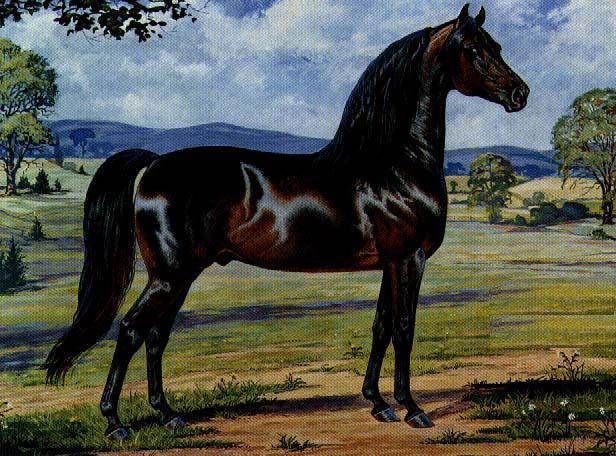
But I didn’t really meet one until I went to Vermont to visit relatives of my mother’s, who raised Morgan horses. I was 7 or 8 at the time, and those horses were very tall! Also, I had never been near a stable before and wasn’t used to the smell of horse manure. There were a lot of men around, stable hands who seemed kind of aloof. Needless to say, the reality of this first encounter did not match the fantasy.morgan-horse-edit.jpg


I didn’t meet my next horse until my family moved to a suburban neighborhood just this side of rural, and there was a field with a cranky pony living in it who bit my thigh when I tried to feed it roses. The bruise, really a huge blood blister, covered most of my thigh and hip. But even so I liked that pony; I could see he had a point of view.horse-eye.jpg I didn’t find myself around horses again until I moved to Santa Barbara, and got it in my head that I wanted to ride English style. I took lessons for a while but never really got the hang of it, or rather I never got over the fear of being thrown.


dressage-edit.jpg

I did befriend one horse, a quarter horse named Port, who had a reputation for being arrogant, but for some reason he liked me. He had the most beautiful canter, but he did not like to gallop. I used to groom and exercise him and ride him around the ring until the lessons got too expensive and I had to stop. Oddly enough, I somehow got on the subject of Port at dinner the other night, and then when I came home and saw the PBS documentary on horse rescue, my memories all started to come back to mingle with feelings of love and the fear, and then revulsion, when they started talking about Premerin ponies.

horse-meat-01_small.jpghorse-meat-06_small.jpg


Fantasy meets reality, indeed.


wild-horses.jpg


Read Full Post »

 101205brain_200×169.jpg I wasn’t going to weigh in on the recent tragedy at Virginia Tech, but after 3 days of watching NBC’s Today Show host Matt Lauer’s petulant, reactionary coverage, I just have to join the fray.

Take this exchange on Tuesday between Lauer and Omar Samaha, whose sister Reema had been murdered:

Lauer: is there anything but anger in your heart for this young man who committed these crimes?

Samaha: Angry? I can’t even say I’m angry yet…There’s nothing that’s going to bring my sister back…and that’s bottom line to me…we’re not the only ones…its important the community is coming together because we are all family here.

I was impressed by Samaha’s reply and the way he dodged, unwittingly or not, Lauer’s vulgar leading question. When Lauer turned back to face the camera, I wasn’t sure if the anger in his expression was due to the story he was covering, or the fact that Samaha didn’t utter the words he wanted to hear.

**************************************

This morning as the details of Seung-hui Cho’s psychological profile came more clearly into focus, Lauer found it important to stress, at least twice, that Cho was not depressed, that he was psychotic. He spat the word “psychotic” out with an edge of disparagement in his voice, as if Cho had chosen psychosis over the more palatable diagnosis of depression as some sort of lifestyle choice.

**************************************

At the turn of the 20th Century authors such as Theodore Dreiser illuminated the harsh realities behind the fiction of the American Dream. In Dreiser’s novel “An American Tragedy” which was based on a true 1906 murder case, the protagonist ( Clyde Griffiths) is found guilty of drowning an ex girlfriend whose murder he pre-planned but did not actually commit. In Dreiser’s fiction Clyde Griffiths was victim of a confrontation of class, money and a need to possess something he thought had been promised to him. Provocative at the time, this theme became a well known and often retold perspective on life in America. At the turn of this century, we are seeing the new, less personal but no less sorrowful ‘American Tragedy,” a confrontation of disenfranchisement, glorified gun culture and misplaced rage being increasingly played out in front of our collective eyes through the media. Instead of great authors revealing the truths of our culture through fiction, we have glowering numb-skulls like Matt Lauer spinning fiction, conjecture and blame before the truth can even unfold.

**************************************

It seemed to me that it would be at least three days before the information I needed to know to begin understanding this case would come to light, and I wasn’t wrong. Beyond the obvious conjectures about his issues with women and disdain for the rich, the details of Cho’s psychological profile are very sad indeed. Multiple complaints of stalking behavior filed by VT coeds, teachers, counselors and acquaintances (he appears to have had no friends) worried about his behavior and his lurid writing, an involuntary stay in a mental hospital during which he was assessed as an imminent danger to himself or others and then released ( a complicated mess of free will and privacy rights), parents who seem to be invisible, the ease with which he was able to lie on his application and purchase his handguns from a dealer who thought he looked like a clean cut college kid; all of these indicators, and still he slipped through the cracks so easily. Like his Columbine mentors before him, Cho is the face of the new American Tragedy, and as things currently stand, we should brace ourselves to see much more of it in the future.


Read Full Post »


palm-tree.jpgRock and roll, baby girl. You can do it. It’s all in your head.” …so said a street drifter in Beverly Hills as I was hurrying blindly towards my car. Silly as it may seem, those words did cheer me up, and they made me aware of just how much I was in my head at that moment – I hadn’t even see the guy as I walked past. As it turns out, it was a beautiful late afternoon, the air smelled of blossoming tress and there was plenty to observe on the boulevard: people sitting and talking in cafes, Japanese teens with mullet haircuts dressed head to toe in Chanel, a pug with a bejeweled collar sniffing the air…

love-from-ojai.jpg

Speaking of sniffing the air, I turn my attention now to an article that appeared in last Wednesday’s L.A. Times food section and sent a chill or horror down my spine. Russ Parsons wrote about the future of farmers’ markets, which is to say that they may become a thing of the past. Why? Because, as Howell Tumlin, executive director of the Southland Farmers’ Market Assn., is quoted as saying, “As a business model, farmers markets couldn’t be more inefficient.” Farming is generally a lean operation, and farmers are spending so much time driving to the various markets scattered all over the southland (Parsons counts close to 100) that they have little time left over for their fields and groves. remember my first lesson in farmers’ marketarturo-from-mcgrath-family.jpg economics, when my favorite farmer confessed that he was selling all his fresh shell beans directly to area restaurants, rather than holding back a few pounds for people like me. Hey, I thought, what about me? Do I now have to go to restaurants and pay their jacked up prices for something I take so much pleasure in cooking at home? But when you look at it from the farmer’s perspective, you just have to understand. What if I don’t show up that week? What if a pound or two doesn’t fit my budget? The restaurant is a bird in the hand. And I am not the safest bet, even I have to admit (I should say, however, that they do bring fresh shell beans to market more and more often, perhaps because the restaurants have made them so popular). Though so far I have lost only one favorite farmer to the full time restaurant supply trade (and they do show up in the summer with their surplus of magnificent heirloom tomatoes), my friend Mary has had to say good-bye to several beloved farmers, because of the economics of selling at Ferry Plaza in San Francisco, which started up as a block of vendors and has now turned into a foodie mecca, replete with permanent shops and restaurants selling everything from gourmet chocolate to olive oil to Christmas cakes imported from Emilia-Romagna, Italy – all at premium prices. My market isn’t nearly so grand. In fact it’s a little funky, as befits its Hollywood neighborhood, which at 8AM on a Sunday, is barely getting over last night’s after hours party when the farmers roll in with their trucks. What will happen if the farmers’ markets lose their farmers to Econ 101? No one is proposing that they sell exclusively to restaurants and grocers, though Whole Foods is making a big push towards local and sustainable, and sports banners with profiles of the farmers they buy from in their produce aisles. There are several concepts being floated, one of which is Community Supported Agriculture, or CSA. Customers are charged an annual ffinley-farms.jpgee, and in return receive weekly produce deliveries. As the Times points out, this model demands that customers share financial risk with the farmer. For instance, a killing freeze like last winter’s might mean more beets than berries. Too much rain, and the rapini might not arrive on cue. After years of weekly visits to farmers’ markets, I’ve already learned this lesson, so no problem there. But while I will happily participate in a CSA, I would be profoundly sorry to see the farmers’ market go. Especially in a city like Los Angeles that is short on community, the Hollywood Farmers’ Market is a community I’ve belonged to for 15 years. Every Sunday morning I drive into Hollywood and buy my food for the week (“bean church” a friend once called it). I‘ve watched kids grow, farms come and go and expand, and I’ve even mourned deaths. The elderly Asian woman whole doled out her luscious Persian mulberries in little tubs, only two per customer, and whose family may have sold her farm, is missed every summer. Dee Dee Throgmartin, an original vendor who threw over her Hollywood career to farm some acres in Riverside and who brought garlic, heirloom vegetables, topical political banter and plans for cheese making to market when cancer got the better of her, is a great loss to the community. I’ve watched trendy vegetables become commonplace. I’ve seen celebrities bagging vegetables without their make-up on. I’ve even adopted kittens from a rescue station at that market. I’ve also watched a street fair vibe infiltrate the market that I’m not crazy about and I try to ignore (I hate the smell of processed lavender oil and patchouli canceling out the smell of greens). But I can’t argue about the stalls serving delicious street foods from L.A.’s multitude of ethnic communities; Salvadorian pupusas, spicy Thai pancakes, Korean kim chee. After my shopping, I love to get some breakfast, and watch the trannies mingle with the Hollywood types sporting their in vitro twins in designer prams.

Can I get that with a CSA?


pupusas-delmy.jpg

Read Full Post »

Design a site like this with WordPress.com
Get started